Cursor hosts the agent loop, inference, and planning. Cloudflare runs commands, file edits, repository operations, and other tools inside infrastructure that you control. The open-source Cursor Cloudflare Workers template ↗ deploys the Worker, Durable Object namespace, container application, R2 bucket binding, and cron trigger used by the integration.
AI Gateway monthly usage invoices, issued at the beginning of each month for the previous month's usage, now show a single total cost for each model. These invoices no longer break out input and output token quantities and unit prices into separate line items. This change does not apply to invoices for AI Gateway credit purchases.
For example, an invoice that previously included these separate line items:
anthropic claude-haiku-4-5-20251001 Input Tokens: 40,000 tokens at $0.000001 ($0.04)
anthropic claude-haiku-4-5-20251001 Output Tokens: 24,000 tokens at $0.000005 ($0.12)
The updated invoice includes one line item: anthropic/claude-haiku-4.5: $0.16.
AI Gateway has also standardized model names across invoices and logs. Model variants that previously appeared with provider-specific version suffixes now use a consistent provider/model identifier.
The /crawl endpoint now respects the use directive of the Content Signals ↗ standard, letting site owners express the maximum level at which their content may be used.
You can declare your intended level with the new contentUse parameter. Allowed values, from least to most permissive, are reference and full, and the default is full. If a target site's robots.txt sets a use level that is more restrictive than your declared contentUse, the crawl request is rejected with a 400 error.
@cf/zai-org/glm-5.3 is now available on Workers AI. It is Z.ai's flagship agentic coding model, built for long-running, tool-driven development workflows rather than single-turn chat.
GLM-5.3 uses the same base model as GLM-5.2, with every gain coming from post-training. The results are substantial on coding and agentic benchmarks: Z.ai reports ↗ a 50% improvement over GLM-5.2 on its in-house Z.ai Code Bench, and calls GLM-5.3 the most capable open-weights model for coding. On public benchmarks, it scores 88.2 on Terminal Bench 2.1 (up from 81.0), 28.3 on Terminal Bench 3.0 — open-source state of the art, up from 4.6 — 66.9 on DeepSWE (up from 46.2), 78.1 on FrontierSWE (up from 67.5), and 42.5 on SWE-Marathon (up from 19.4). It is also the top-scoring model in Z.ai's comparisons on CyberGym for vulnerability discovery (84.5) and on long-horizon automation tasks like AutomationBench (48.2).
The price-to-performance ratio is the compelling part. On Workers AI, GLM-5.3 costs the same as GLM-5.2 — $1.40 per M input tokens, $0.26 per M cached input tokens, and $4.40 per M output tokens — while roughly doubling GLM-5.2's scores on long-horizon benchmarks like SWE-Marathon, and improving them by more than 6x on Terminal Bench 3.0.
AI Search now supports six additional Workers AI models for text generation:
Model
Context window (tokens)
@cf/deepseek-ai/deepseek-v4-flash-0731
1,048,576
@cf/deepseek-ai/deepseek-v4-pro-0813
1,048,576
@cf/openai/gpt-oss-120b
128,000
@cf/openai/gpt-oss-20b
128,000
@cf/qwen/qwen3.8-27b
262,144
@cf/moonshotai/kimi-k2.7-code
262,144
These models run on Workers AI, so they do not require an additional provider key. Select a model when creating or updating an AI Search instance in the dashboard or through the API.
For the full list of supported models, refer to Supported models.
@cf/zai-org/glm-5.3-flash is now available on Workers AI. It is the first natively multimodal model in the GLM-5 series, built on a Mixture-of-Experts architecture with 320B total parameters and 18B active per token.
GLM-5.3 Flash is the first GLM-family model on Workers AI to support multimodal inputs. It outperforms GLM-5.2 across benchmarks and real-world workloads at a lower price, while approaching Claude Opus 4.8 on coding and agentic benchmarks.
AI Search supports larger custom metadata values within a shared 10 KiB metadata envelope for each vector. The envelope includes AI Search system metadata and JSON overhead, so it is not a per-field limit. The first 64 UTF-8 bytes of each indexed string remain filterable.
Wrangler and the Cloudflare API MCP server now use optional OAuth scopes. During authorization, you can choose which optional scopes to grant instead of approving every scope requested by each client.
The consent dialog now includes the option to edit the permissions you grant to Wrangler or the Cloudflare API MCP server:
You can then choose which specific permissions to grant:
Required scopes remain selected. Choosing fewer optional scopes limits each tool's access to the permissions needed for your workflow.
If a command or tool call needs a scope that you declined, reauthorize the client and grant that scope.
Browser Run lets you automate headless browsers on Cloudflare's global network. Run full browser sessions for interactive workflows, or use Quick Actions for one-request tasks such as screenshots, PDFs, and capturing page content.
You can now run hundreds of browser sessions in parallel, launch new browsers faster, and process three times as many Quick Actions per second. These published limits are defaults, not maximums. If your workload needs more more concurrent browsers, request higher limits ↗.
GPT-5.6 Sol is available through AI Gateway, and for a limited time you can use it at 50% off. If you are already using AI Gateway, point to the openai/gpt-5.6-sol model and the discounted pricing applies automatically — no promo code needed.
The promotion is available for Unified Billing users only (not Bring Your Own Keys). Load credits onto AI Gateway and start sending requests to openai/gpt-5.6-sol.
Discounted pricing during the promotion:
Usage
Promotional price
Standard price
Input
$2.50 per 1M tokens
$5 per 1M tokens
Output
$15 per 1M tokens
$30 per 1M tokens
Cache read
$0.25 per 1M tokens
$0.50 per 1M tokens
The promotion runs through September 18, 2026. After that date, GPT-5.6 Sol requests return to standard pricing.
Qwen 3.8 27B is a 27-billion-parameter instruction-tuned vision language model from Alibaba's Qwen family. It processes images and text together, with reasoning and function calling for agentic workflows.
Key capabilities:
Vision: Accept image and text inputs and generate text responses.
Reasoning: Support thinking mode for complex, step-by-step problem-solving.
Function calling: Build agents that invoke tools and APIs across multiple conversation turns.
262,144 token context window: Retain long conversations and multimodal inputs across extended agent sessions.
Use Qwen 3.8 27B through the Workers AI binding (env.AI.run()) or the REST API at /ai/run. You can also use AI Gateway with these endpoints.
DeepSeek V4 Flash and DeepSeek V4 Pro are the first Workers AI models with a full one million (1,048,576) token context window. Use them for long-horizon agentic workflows, large codebases, and multi-step reasoning that exceed the context limits of every other model hosted on the platform.
DeepSeek V4 Flash is the faster, lower-cost sibling. This release supersedes the preview version with substantially enhanced agentic capabilities.
Key capabilities:
Reasoning: Both models support thinking mode for complex, step-by-step problem-solving.
Function calling: Build agents that invoke tools and APIs across multiple conversation turns.
Long context: Both models support a full 1,048,576 token context window.
Workers AI and AI Gateway now provide a unified path for accessing models and managing inference traffic. Use the same AI binding and REST API to call models hosted on Workers AI or by supported third-party providers, with AI Gateway providing observability, logging, caching, security, and billing controls.
Unified entrypoints and observability
The AI binding supports both Workers AI and third-party models through env.AI.run(). The REST API provides shared /ai/ endpoints with Cloudflare authentication across providers.
Route a Workers AI request through AI Gateway by specifying a gateway ID. Use default to automatically create a gateway on the first authenticated request, or specify an existing gateway to separate applications and workloads:
const response = await env.AI.run( "@cf/zai-org/glm-5.2", { messages: [{ role: "user", content: "What is the capital of France?" }], }, { gateway: { id: "default" }, },);
const response = await env.AI.run( "@cf/zai-org/glm-5.2", { messages: [{ role: "user", content: "What is the capital of France?" }], }, { gateway: { id: "default" }, },);
Requests routed through AI Gateway can be logged and included in analytics for request volume, errors, latency, token usage, and costs. You can also configure controls such as caching, rate limiting, and request retries on the gateway.
Unified billing and higher rate limits
You can now use prepaid AI Gateway credits to pay for Workers AI inference. This provides one credit balance for Workers AI and supported third-party model providers. To use credits for Workers AI, set the gateway's Workers AI billing setting to Unified billing. Workers AI requests routed through that gateway deduct from your credit balance in real time.
Prepaid credits also provide access to the following Workers AI frontier models without requiring the Workers Paid plan. Each frontier Workers AI model has a rate limit of 50 requests per minute per account, per model when billed with AI Gateway credits, compared to 20 requests per minute through standard Workers AI billing:
Sandbox SDK 1.0 is available to preview under the npm @next tag. For existing applications, the current stable package remains published on the 0.12.x line.
Sandbox SDK first shipped to provide a rich library for running untrusted and agent-driven work on Cloudflare Containers. Since then, both Sandbox and Containers have matured. This preview is a thinner SDK built on a richer Cloudflare Containers foundation.
npm i @cloudflare/sandbox@next
yarn add @cloudflare/sandbox@next
pnpm add @cloudflare/sandbox@next
bun add @cloudflare/sandbox@next
What this preview is
A single execution interface — sandbox.exec() takes an argument list, returns when the process starts, and gives you a handle for output, logs, waits, and signals. Both short commands and long-running services use the same API.
Removed session execution — the SDK no longer maintains shell state between executions. Each launch is independent. Pass cwd and env when you need them, or put multi-step shell syntax in one explicit shell command.
RPC as the only transport — the SDK talks to the container exclusively over RPC. Remove SANDBOX_TRANSPORT, transport on getSandbox(), and setTransport().
Improved PTY and terminal interface — interactive PTYs use createTerminal / connect, not the older session-shaped helpers.
Code interpreter as an extension — configure the code interpreter on your Sandbox subclass so you only ship what you need.
Start new projects on @next. Migrate existing apps when you can so you are ready when 1.0 becomes stable. Deploy the Worker package and container image from the same@next line.
Coding agents: install Cloudflare Skills ↗ (Agent setup). Use sandbox-next for @next (recommended for new projects), sandbox-stable for the current stable package, and sandbox-migrate-to-next when you are ready to port. Stable-package deprecated-API cleanup is in the 2026 deprecation guide.
The main Sandbox documentation still describes today's stable package. Preview docs:
The self-deployed Sandbox bridge is not currently part of this preview. We are working on bringing it in line with the latest code. Until then, use the stable bridge with the matching stable package and container image.
Timeline for 1.0
Further Cloudflare Containers features will let us keep reducing the size of the Sandbox SDK. We aim to ship Sandbox SDK 1.0 once those are in. In the meantime we continue to support and maintain the 1.0 preview (@next) alongside the current stable release.
AI Search gets you from a data source to a working search endpoint quickly. This release adds what you need to put that endpoint in front of real users: your own domain, authentication, and one endpoint across several instances. It also adds crawling for sites without a complete sitemap, so your index covers everything you want it to find.
Each of the following is a new option. The previous behavior is still the default, so nothing changes until you change it.
Serve search from your own domain
A public endpoint is a URL that a site or app can query directly, with no authentication in front of it. By default that URL is a generated hostname on search.ai.cloudflare.com. You can now serve the same endpoint from a custom domain, a hostname in a zone that you own:
https://search.example.com/search
Restrict who can query your content
Once your endpoint is on your own domain, you can put Cloudflare Access in front of it. For example, you usually want to give /mcp to specific agents rather than to anyone who finds the URL. Agents authenticate with an Access service token, and people who open the endpoint in a browser sign in through your identity provider.
Search several instances from one URL
A namespace can expose its own public endpoint with /search, /chat/completions, and /mcp paths that fan out across the instances you choose:
curl https://ns-<NAMESPACE_ENDPOINT_ID>.search.ai.cloudflare.com/search \
  --header "Content-Type: application/json" \
  --data '{
    "messages": [{ "content": "How do I configure AI Search?", "role": "user" }],
    "ai_search_options": { "instance_ids": ["docs", "support"] }
  }'
Index your sites without a sitemap
Website data sources support a new discoverparse type. It starts at the source URL and collects pages from both your sitemaps and the links it finds while crawling:
Kitesurf is Cloudflare's new stateless, highly scalable browser that runs entirely on top of Workers and is designed for AI agents. It is available for free while in beta.
Compared to Chromium, Kitesurf uses 3–7× less CPU and memory for common agentic tasks like screenshots and HTML extraction, so you can run more sessions and scale better for bursty, AI-driven workloads.
Your existing clients already work. To opt in, add the browser=kitesurf parameter to any Browser Run CDP or Quick Action endpoint:
AI Gateway now includes User Insights, a dashboard that gives you two things at once: clear visibility into how much your organization spends on AI, and a security signal that surfaces users whose usage suddenly looks abnormal. It works on the traffic already flowing through your gateway, so there is no additional setup.
On the spend side, User Insights shows organization-wide totals for cost, requests, tokens, and adoption, and lets you drill into an individual user to see their spend, top models and providers, cache hit rate, and more. To attribute usage to individual users, add a user identifier with custom metadata or put your gateway behind Cloudflare Access.
On the security side, User Insights baselines each user's normal usage from their 95th percentile (p95) session cost over the last 30 days, then flags sessions that exceed both that baseline and an organization-level threshold. A sudden jump above a user's own pattern is often the first sign of a compromised credential or a misbehaving agent, so you can investigate before it shows up on your bill.
User Insights is available to all AI Gateway customers at no additional cost.
AI Gateway now integrates with Cloudflare Access, giving you two new capabilities:
Protect your gateway endpoint. Put your AI Gateway behind Access so you can set policies that control who is allowed to call a specific gateway's endpoint.
Identity-aware controls. When traffic reaches AI Gateway through an Access-protected custom domain, AI Gateway can use the authenticated user's Access identity in logs, analytics, routing, and spend controls.
With identity-aware controls, you can set spend limits by authenticated user, control which gateways different users can access, filter logs by user, and build policies without passing user IDs from the client application. AI Gateway adds the verified Access user ID to request metadata as cf.user_id.
Agent tracing is now available for applications built with the Agents SDK. Traces show each agent turn alongside model calls, tool runs, approvals, token usage, and Workers runtime operations.
Turn on Workers tracing in your Wrangler configuration:
Think and Flue applications emit agent traces automatically. For direct AI SDK calls, wrap the AI SDK namespace once. wrapAISDK() supports AI SDK v6 and v7. This AI SDK v7 example also supplies the agent identity:
import * as ai from "ai";import { wrapAISDK } from "agents/observability/ai";const tracedAI = wrapAISDK(ai);await tracedAI.generateText({ model, prompt: "Find an available appointment", runtimeContext: { agentId: "booking-agent-production", conversationId: "conversation-123", }, telemetry: { functionId: "booking-agent", includeRuntimeContext: { agentId: true, conversationId: true, }, },});
import * as ai from "ai";import { wrapAISDK } from "agents/observability/ai";const tracedAI = wrapAISDK(ai);await tracedAI.generateText({ model, prompt: "Find an available appointment", runtimeContext: { agentId: "booking-agent-production", conversationId: "conversation-123", }, telemetry: { functionId: "booking-agent", includeRuntimeContext: { agentId: true, conversationId: true, }, },});
Message and tool payload recording is off by default. Turn it on only when the payloads are safe to store:
Open the Agents tab ↗ in the Cloudflare dashboard to inspect sessions, replay conversations, and view trace waterfalls. For advanced setup, privacy controls, and trace structure, refer to Agent tracing.
You can now store up to 20 million vectors in a single Vectorize index, doubling the previous limit of 10 million vectors. This enables larger-scale semantic search, recommendation systems, and retrieval-augmented generation (RAG) applications without splitting data across multiple indexes.
Vectorize continues to support indexes with up to 1,536 dimensions per vector at 32-bit precision. Refer to the Vectorize limits documentation for complete details.
We're releasing an early preview of @cloudflare/computer ↗, an open-source agent runtime that gives every agent its own computer. The runtime dynamically orchestrates between fast, efficient isolates and full Linux containers, so the agent always runs on the right compute primitive for the task at hand.
@cloudflare/computer provides a virtual filesystem backed by SQLite, which you can populate from cloud storage, source control, or any files you choose. Agents can read, write, and edit files, run shell commands, and interact with Git repositories. All operations are gated, audited, and observed.
Install the package via npm:
npm install @cloudflare/computer
Instantiate a Workspace inside any Durable Object to give your agent a filesystem and execution runtime:
import { Workspace } from "@cloudflare/computer";export class Agent { workspace = new Workspace({ storage: this.ctx.storage, });}
Several execution backends are included or you can write your own:
Isolate runtime — fast, horizontally scalable execution via just-bash and Dynamic Workers, ideal for file manipulation and data processing.
Container runtime — full Linux environment via Cloudflare Containers, mounted through FUSE, for tasks that need native binaries, package managers, or a complete userland.
The AI SDK-compatible toolkit provides common agent tools (read, write, edit, ls, exec) and guides the model to choose the appropriate backend for each task.
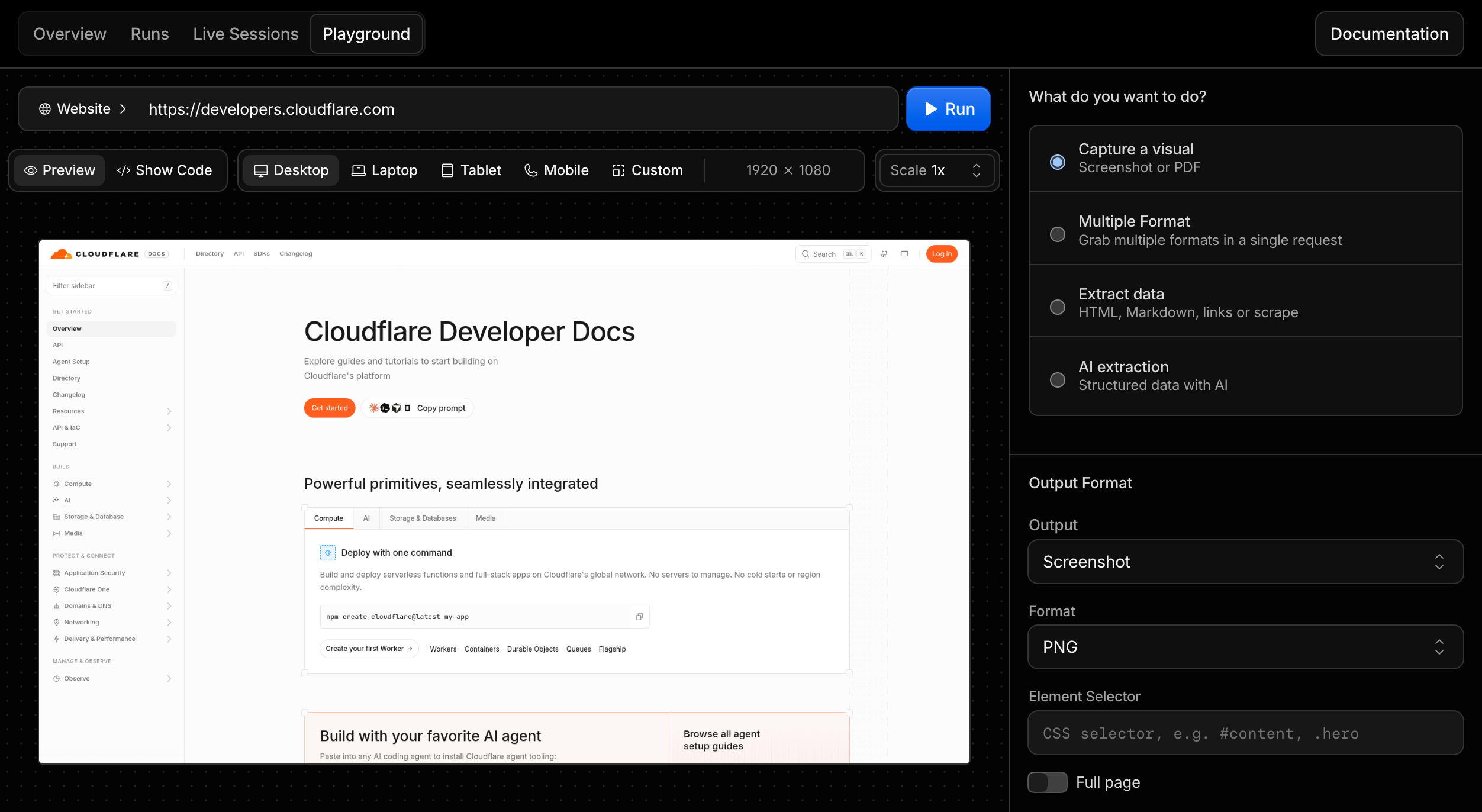
Browser Run now includes a Playground in the Cloudflare dashboard. Use it to try Quick Actions against a live browser without creating a Worker, installing an SDK, or deploying code first.
The Playground helps you test a target URL or raw HTML input, tune viewport and page-load settings, preview the output, and copy working code for the same request.
You can also configure desktop, laptop, tablet, mobile, or custom viewport sizes, set browser scale, choose page-load conditions, set timeouts, and wait for selectors before running a request.
Select Show Code to generate the same request as cURL, TypeScript SDK, Python, or Workers Binding code. For example, a screenshot request can be copied as a Workers Binding call:
You can now use AI Search directly from popular agent frameworks, adding grounded retrieval to an existing app instead of calling the REST API by hand. The new Agents section has guides for the Vercel AI SDK, LangChain, and the Cloudflare Agents SDK. The AI SDK integration is a new package, and the LangChain integration is a new retriever in the existing langchain-cloudflare package.
Vercel AI SDK
The ai-search-provider ↗ package connects AI Search to the AI SDK, and targets AI SDK v6 (ai@^6). Pass instance.chat() to generateText or streamText to generate a response grounded in your indexed content, with the retrieved chunks returned as sources. You can also expose instance.search() as a tool for agent loops.
The langchain-cloudflare package (PyPI ↗, GitHub ↗) provides CloudflareAISearchRetriever, a standard LangChain retriever backed by AI Search. Use it on its own, wrap it with create_retriever_tool to give an agent a search tool, or drop it into a RAG chain. It works with REST credentials or a Worker binding inside a Python Worker.
from langchain_cloudflare import CloudflareAISearchRetrieverretriever = CloudflareAISearchRetriever( account_id=ACCOUNT_ID, api_token=API_TOKEN, instance_name="knowledge-base", retrieval_type="hybrid",)docs = retriever.invoke("How do I configure Workers AI?")
Cloudflare Agents SDK
The Cloudflare Agents SDK could already reach AI Search through the Workers binding. The new guide walks through building a stateful chat agent that provisions its own instance, indexes content, and searches it from a tool.
import { tool } from "ai";import { z } from "zod";const instance = env.AI_SEARCH.get("knowledge-base");// Expose AI Search to the agent's model as a tool it can call.const searchKnowledgeBase = tool({ description: "Search the knowledge base for relevant content.", inputSchema: z.object({ query: z.string() }), execute: ({ query }) => instance.search({ query }),});
import { tool } from "ai";import { z } from "zod";const instance = env.AI_SEARCH.get("knowledge-base");// Expose AI Search to the agent's model as a tool it can call.const searchKnowledgeBase = tool({ description: "Search the knowledge base for relevant content.", inputSchema: z.object({ query: z.string() }), execute: ({ query }) => instance.search({ query }),});
For the full walkthroughs, including creating an instance and indexing content, refer to the Agents guides.
Cloudflare's product-specific MCP servers now support the new MCP 2026-07-28 Specification. Each request runs on a fresh stateless server without an MCP protocol session or protocol-specific Durable Object.
The /mcp endpoint also accepts stateless requests from 2025 Streamable HTTP clients. Most clients can reconnect without configuration changes.
Use /mcp for new connections. Historical /sse URLs continue to work as aliases for the same Streamable HTTP handler, but they no longer serve the deprecated HTTP+SSE transport. If a client forces SSE transport, change it to Streamable HTTP or automatic transport detection.