---
title: Register the Cloudflare One Client with minimal user interaction
description: Register the Cloudflare One Client with minimal user interaction in Zero Trust.
image: https://developers.cloudflare.com/zt-preview.png
---
> Documentation Index
> Fetch the complete documentation index at: https://developers.cloudflare.com/cloudflare-one/llms.txt
> Use this file to discover all available pages before exploring further.
[Skip to content](#%5Ftop)
### Tags
[ PowerShell ](https://developers.cloudflare.com/search/?tags=PowerShell)
# Register the Cloudflare One Client with minimal user interaction
Administrators can automate Cloudflare One Client (formerly WARP) registration on managed devices and minimize the number of clicks required from an end user.
During the default Cloudflare One Client enrollment process, end users typically need to complete several steps in order to login:
1. Review Terms and Conditions in the Cloudflare One Client GUI and acknowledge your company's use of the Cloudflare One Client.
2. Select their identity provider from the Cloudflare Access login screen.
3. Complete the authentication steps required by the identity provider.
4. Interact with a browser popup requesting permission to launch the Cloudflare One Client.
This guide covers how to eliminate steps 1, 2 and 4 from your Cloudflare One Client deployment.
Service token authentication
If you are looking to eliminate all user interaction, you can [enroll devices using service tokens](https://developers.cloudflare.com/cloudflare-one/team-and-resources/devices/cloudflare-one-client/deployment/device-enrollment/#check-for-service-token). Because users are not required to log in to an identity provider, identity-based policies and logging will not be available on these devices.
On iOS and Android / ChromeOS, end users will still be asked questions required by their platform such as accepting notifications or installing the VPN Profile.
## Turn off onboarding screens
To skip the Terms and Conditions screens that are usually presented to users, set the [onboarding parameter](https://developers.cloudflare.com/cloudflare-one/team-and-resources/devices/cloudflare-one-client/deployment/mdm-deployment/) to `false` in your [MDM deployment file](https://developers.cloudflare.com/cloudflare-one/team-and-resources/devices/cloudflare-one-client/deployment/mdm-deployment/). Here is an example `mdm.xml` file:
```
organization
your-team-name
onboarding
```
## Turn on instant authentication
If you are only using one identity provider for device enrollment, turn on **Apply instant authentication** in your [device enrollment permissions](https://developers.cloudflare.com/cloudflare-one/team-and-resources/devices/cloudflare-one-client/deployment/device-enrollment/#set-device-enrollment-permissions). This allow users to skip the Cloudflare Access login page and go directly to your SSO login event.
## Allow browser to launch the Cloudflare One Client
You can configure your browser to automatically launch the Cloudflare One Client application after a successful login and skip the **Open Cloudflare WARP.app** popup.
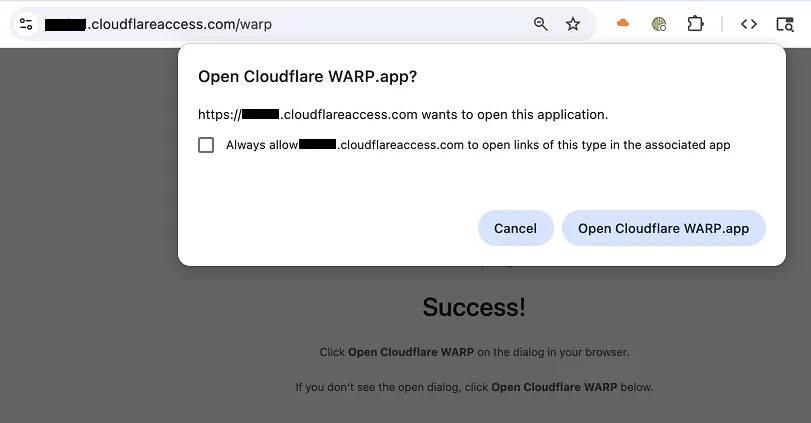
_Note: Labels in this image may reflect a previous product name._
### Chromium-based browsers
Chromium-based browsers such as Google Chrome and Microsoft Edge have a policy setting called [AutoLaunchProtocolsFromOrigins ↗](https://learn.microsoft.com/en-us/DeployEdge/microsoft-edge-policies#autolaunchprotocolsfromorigins). This setting takes in two parameters: a protocol for the browser to launch and the origins that are allowed to launch it. For the browser to launch the Cloudflare One Client, you need to set the protocol to `com.cloudflare.warp` and the origin to your Cloudflare Zero Trust team domain (`https://.cloudflareaccess.com`).
* [ Windows ](#tab-panel-5227)
* [ macOS ](#tab-panel-5228)
On Windows, you can configure `AutoLaunchProtocolsFromOrigins` by adding a new registry key.
To add the registry key manually:
1. Open Registry Editor as Administrator.
2. Navigate to the policies folder for your browser:
* Google Chrome: `HKEY_LOCAL_MACHINE\SOFTWARE\Policies\Google\Chrome`
* Microsoft Edge: `HKEY_LOCAL_MACHINE\SOFTWARE\Policies\Microsoft\Edge`
Note
You may need to create the `HKEY_LOCAL_MACHINE\SOFTWARE\Policies\Google\Chrome` folder if it does not already exist.
3. Create a new string value:
* **Value Name**: `AutoLaunchProtocolsFromOrigins`
* **Value Data**: `[{"allowed_origins": ["https://.cloudflareaccess.com/"], "protocol": "com.cloudflare.warp"}]`
Be sure to replace `` with your actual Zero Trust team name.
Instead of using the Registry Editor, the registry key can also be created using a Group Policy Object (GPO), PowerShell script, or with an MDM such as [Intune](https://developers.cloudflare.com/cloudflare-one/team-and-resources/devices/cloudflare-one-client/deployment/mdm-deployment/partners/intune/#update-mdm-parameters).
On macOS, you can configure `AutoLaunchProtocolsFromOrigins` by deploying a property list (plist) file for the browser. The exact instructions will vary depending on your [MDM](https://developers.cloudflare.com/cloudflare-one/team-and-resources/devices/cloudflare-one-client/deployment/mdm-deployment/partners/). The general procedure is as follows:
1. Create a new plist file with the following name (case sensitive):
* Google Chrome: `com.google.Chrome.plist`
* Microsoft Edge: `com.microsoft.Edge.plist`
2. Using a text editor, add the following content to your plist:
```
AutoLaunchProtocolsFromOrigins
allowed_origins
https://.cloudflareaccess.com
protocol
com.cloudflare.warp
```
Be sure to replace `` with your actual Zero Trust team name.
3. Some MDMs require converting the `.plist` to a `.mobileconfig` before pushing it to a device. You can use a [file converter ↗](https://github.com/timsutton/mcxToProfile) or modify the following example `com.google.Chrome.mobileconfig`:
```
PayloadIdentifier
com.google.chrome
PayloadRemovalDisallowed
PayloadScope
System
PayloadType
Configuration
PayloadUUID
8FCBDCA7-87B3-4610-A01A-B0FE4C5B57C8
PayloadOrganization
PayloadVersion
1
PayloadDisplayName
Google Chrome Policy
PayloadContent
PayloadType
com.apple.ManagedClient.preferences
PayloadVersion
1
PayloadIdentifier
com.normandale
PayloadUUID
8FCBDCA7-87B3-4610-A01A-B0FE4C5B57C8
PayloadEnabled
PayloadDisplayName
Custom: (com.google.Chrome)
PayloadContent
com.google.Chrome
Forced
mcx_preference_settings
AutoLaunchProtocolsFromOrigins
allowed_origins
https://.cloudflareaccess.com
protocol
com.cloudflare.warp
```
4. Upload the `.plist` or `.mobileconfig` file to your preferred MDM.
5. Deploy the configuration profile to your devices.
For more information on configuring browser policies on macOS, refer to the [Google Chrome ↗](https://support.google.com/chrome/a/answer/9020077?hl=en&ref%5Ftopic=7650028&sjid=15337530832025656704-NA) or [Microsoft Edge ↗](https://learn.microsoft.com/en-us/deployedge/configure-microsoft-edge-on-mac) documentation.
```json
{"@context":"https://schema.org","@type":"BreadcrumbList","itemListElement":[{"@type":"ListItem","position":1,"item":{"@id":"/directory/","name":"Directory"}},{"@type":"ListItem","position":2,"item":{"@id":"/cloudflare-one/","name":"Cloudflare One"}},{"@type":"ListItem","position":3,"item":{"@id":"/cloudflare-one/team-and-resources/","name":"Team and resources"}},{"@type":"ListItem","position":4,"item":{"@id":"/cloudflare-one/team-and-resources/devices/","name":"Devices"}},{"@type":"ListItem","position":5,"item":{"@id":"/cloudflare-one/team-and-resources/devices/cloudflare-one-client/","name":"Cloudflare One Client"}},{"@type":"ListItem","position":6,"item":{"@id":"/cloudflare-one/team-and-resources/devices/cloudflare-one-client/deployment/","name":"Deploy the Cloudflare One Client"}},{"@type":"ListItem","position":7,"item":{"@id":"/cloudflare-one/team-and-resources/devices/cloudflare-one-client/deployment/mdm-deployment/","name":"Managed deployment"}},{"@type":"ListItem","position":8,"item":{"@id":"/cloudflare-one/team-and-resources/devices/cloudflare-one-client/deployment/mdm-deployment/protocol-handler/","name":"Register the Cloudflare One Client with minimal user interaction"}}]}
```